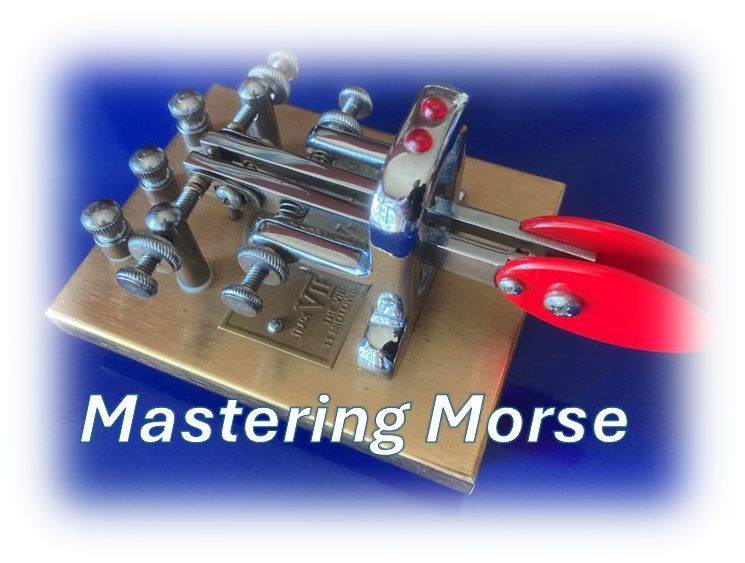

Improving your Sending
Make it a daily habit. After the morning coffee, ten minutes of sending practice.
Ask a friend or another member for feedback. Or, put a short note on your qrz.com profile that you welcome feedback.
Hopefully, most of us listen to CW at least once a week. My shack is also my office, so I have common frequencies running most days.
Be aware of bad habits that easily creep into your sending. Typical examples include:
- Running together letters in your callsign, name or QTH – phrases or words you send are often prime candidates for falling foul of bad habits.
- Another gremlin to watch for is bad ti min g. No th ing m akes it har der to enj oy relax ed cop ying than poo r t iming.
- Good character spacing, but running words together.
Inadequatespacingbetweenwordscanmakecopyingcwmoredifficultthanitneedstobe. - If you are using a paddle and electronic keyer, you are assured of excellent dit & dah formation – your failings will likely be spacing. Full Iambic keying and “squeeze” keying will help, but it needs a lot of practice.
- If you use a straight key, you need practice; try recording your sending and play it back. Ask others for honest feedback.
- It can be all too easy to send faster than you’re comfortable with; and this impacts the quality and consistency of your sending, and may also impact your receiving (its too easy to send faster than you can receive – at the slower speeds)
- If you’re sending too fast, it might sound to others (and feel for you) a bit like you’re running down a hill too fast… your sending becoming just a little sloppy with trips and occasional falls.
- We all have phones capable of recording… try recording your sending and then listening to it. How does the timing sound?
A really good habit is to send some pangrams prior to getting on air. A pangram is a sentence that uses all 26 characters of the alphabet. Consider it a “quick warm up session” prior to on-air operation. Just about every sportsperson and musician warms up before a performance; consider your on-air transmission a performance. Do it justice and warm up first.
You can download a PDF of Pangrams here: <insert link to PDF>
Receiving
There is only one way to achieve your goals when learning and copying CW.
Practice, practice, practice
Easy to say, harder to do. Right?
No. The hard part is establishing a routine and sticking to it. How many other voluntary routines do we follow simply because we find them easy, or requiring minimal effort…. Like surfing Facebook, or the web? Maybe we spend 15 min each morning having a coffee and reading the paper? Walking the dog/cat/chicken/sheep?
If you are serious about mastering the code, you’ll find a way to build 15-20 minutes into your daily routine. Mobile phones offer all sorts of possibilities to integrate some learning into other routines… like walking the dog/cat/chicken/sheep whilst listening to practice sessions. Maybe take a sandwich to work and spend the time doing your CW exercises whilst eating lunch?
Ditch the rubbish television soaps for eight weeks and replace with 45 mins Morse Code learning sessions. Or join CW Academy.
Book a 15 minute session twice weekly with a CW buddy; integrate learning CW into getting some on-air time.
Set a goal – two QSOs a day at least six days a week. Force yourself to either increase the speed a little and/or break into a conversation – even if it’s just telling the other op about your station, antenna or wx.
I could go on….
Where-ever you are on the journey to learning Morse Code, your only sure-fire way to success is daily practice.
If you’d like an accountability buddy, just email me and we’ll find someone who is willing to work with you to maintain a rigid routine.
So… if you’re willing to commit and need some inspiration or just someone to provide moral support, reach out. Your best chance of success is to have someone who can be that little voice on your shoulder. (or inside your head).
Last modified: 1 December, 2025