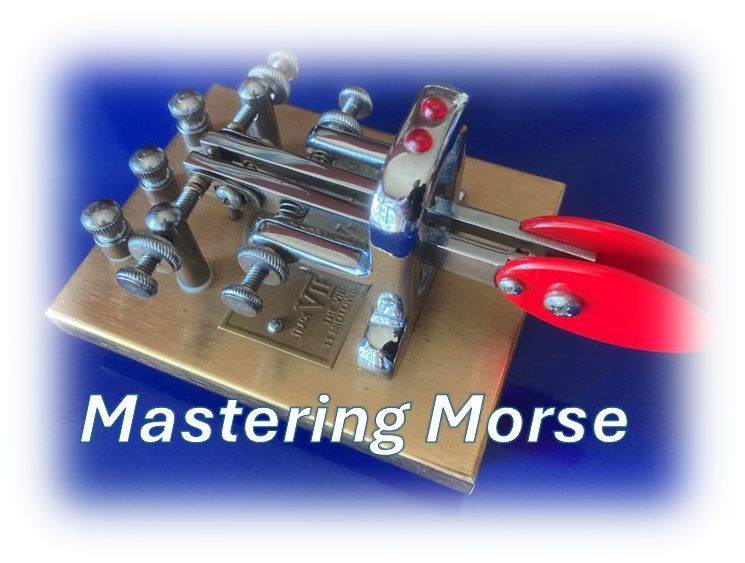

Skills Development – Muscle Memory
Muscle memory for Morse code involves using repetitive physical actions, like straight key presses, bug or paddle combinations to build and reinforce neural pathways for the dot-dash sequences, making it an automatic, unconscious process.
A good analogy is driving a manual car. Those of us who learnt on a manual gearbox will remember the confusion and concentration required to work through the gear changes; pressing the clutch, changing gear, releasing the clutch, working the indicators, steering, and trying to ignore all the helpful advice from Mum and Dad. 😉 Yet a few short weeks later, changing gears became easier, and after some time a completely automatic process. A good example of muscle memory at work.
This phenomenon was demonstrated very well on my recent trip to Norfolk Island. Over the years I have built a strong muscle memory for sending my callsign “VK3QB”, as well of course as my name, QTH and a few other important brief phrases. Well, it took a good few hours to force a new callsign into my muscle memory, that being “VK9NT”. Even after a few days, if I was tired and operating on auto-pilot, I was aware of a propensity to revert to my VK3QB muscle memory.
“Research shows learning Morse code improves neuroplasticity, altering the brain’s white matter and enhancing the inferior longitudinal fasciculus (ILF), a region associated with object recognition, language and cognition. While the term “muscle memory” typically refers to motor skills, a study demonstrated that learning Morse code, a skill involving acoustic patterns and short-term memory, also leads to structural changes in the brain’s white matter.” Source: Google AI
In other words, as we commit a letter, word, or phrase to memory it forms a pattern in our brains, thereby enabling faster, more “automatic” recognition. This is far quicker and more efficient that the old fashioned “look up table” so many of us learnt when we first started with Morse Code. And it works for both sending and receiving.
The key to building your muscle memory is repetition and reinforcement. Most simply:
Initial Learning: When you first learn Morse code, you rely on conscious effort to recall and execute each dot and dash sequence. To make your end game more efficient and easier to achieve, learn the code at least at 18-20WPM. At these speeds you are hearing the dot-dash sequence from the outset, and not trying to count dits and dahs.
Practice and Automation: With practice, your brain begins to process these patterns more efficiently. Practice daily, both sending and receiving. By using more than one mode (ie. Sending and receiving) you are creating a more effective learning environment.
Automatic reflex: Eventually, the sequence of movements for sending or recognising a character becomes semi-automatic, requiring less conscious thought. This is when it’s considered “muscle memory”.
Also, make sure you are developing an accurate muscle memory. Record your sending, and practice off-air to make sure the rhythm and timing is accurate.
The best way to develop muscle memory is regular practice. Daily is ideal… at least 10-15 minutes. If you can manage 20-30 minutes that’s even better.
Give it a try… you’ll start seeing progress in just a few days.
Last modified: 1 December, 2025